Welcome to the Kunena forum!
Tell us and our members who you are, what you like and why you became a member of this site.
We welcome all new members and hope to see you around a lot!
TOPIC: Richard Mille Watches replica
|
Richard Mille Watches: The Hyper-Tech Brand at the Forefront of AI-Driven Watchmaking
Introduction In the span of just over two decades, Richard Mille has done what most watch brands take centuries to achieve: it has redefined the very language of luxury watchmaking. Founded in 2001 by Richard Mille and Dominique Guenat in partnership with Audemars Piguet, the brand burst onto the horological scene with a singular vision — to apply the engineering philosophy of Formula 1 racing and aerospace technology to mechanical wristwatches. The result was a collection of timepieces that looked like nothing that had come before: skeletonized movements suspended in architectural cases, exotic materials borrowed from motorsport and missile technology, and prices that positioned Richard Mille not just as a luxury brand but as a hyper-luxury phenomenon. Today, as artificial intelligence reshapes watchmaking , Richard Mille is uniquely positioned — perhaps more than any other brand — to serve as the exemplar of how AI can amplify an already technology-obsessed horological philosophy. This article explores how AI is transforming every link of the watchmaking chain, with Richard Mille as the ultimate case study of technology-driven horological innovation. The Richard Mille Philosophy: Racing Engineering as Horological DNA "A Racing Machine on the Wrist" Richard Mille's founding philosophy was articulated in a single, powerful concept: every watch should be a "racing machine on the wrist." This was not a marketing metaphor but an engineering mandate. The brand's first timepiece, the RM 001 Tourbillon , featured a movement designed with the same principles that govern Formula 1 car construction — extreme weight reduction, structural rigidity through skeletal architecture, and material selection driven by functional requirements rather than tradition or aesthetics alone. This philosophy extends to every aspect of Richard Mille's design process. Cases are engineered to dissipate impact energy the way a racing car's chassis absorbs collision forces. Movements are skeletonized not merely for visual effect but to eliminate every gram of unnecessary mass. Materials like NTPT carbon (North Thin Ply Technology), Carbon TPT , and Graph TPT — originally developed for racing yacht masts and America's Cup boats — are selected for their exceptional strength-to-weight ratios. This obsession with engineering optimization makes Richard Mille the most natural candidate in the entire watch industry for AI integration — because the brand's design philosophy is, at its core, an algorithmic one: optimize for performance, minimize for weight, and let form emerge from function. high quality replica watches replica urwerk watches replica richard mille Rafa Nadal Why Richard Mille Is the Ultimate AI Watchmaking Case Study Unlike traditional watch brands whose design processes are rooted in aesthetic heritage and artisanal tradition, Richard Mille's methodology is fundamentally engineering-driven. Every design decision is justified by a functional rationale, every material choice is supported by performance data, and every component is optimized for its specific operational role. This data-driven, performance-obsessed approach is precisely the kind of design philosophy that AI excels at augmenting. When an AI system is tasked with optimizing a watch case for impact resistance, it is essentially performing the same analytical process that Richard Mille's engineers perform manually — but at a scale and speed that is orders of magnitude beyond human capability. AI in Design: Generative Engineering for Skeletonized Architecture Generative Design and the RM Movement Architecture The skeletonized movement architecture that defines every Richard Mille timepiece — where the movement plate and bridges are reduced to their absolute structural minimum, creating a visual aesthetic that resembles a high-tech architectural framework — is a perfect candidate for generative design optimization . AI-powered generative design tools, such as those integrated into Autodesk Fusion 360 and Siemens NX, can explore thousands of bridge geometries in a matter of hours, each one evaluated for structural rigidity, weight minimization, and manufacturing feasibility. For a brand like Richard Mille, whose movements are engineered to withstand accelerations of up to 5,000 Gs — the force experienced in a severe impact — this kind of AI-driven structural optimization is not a luxury but a necessity. An AI system can simulate the stress distribution across a movement bridge under various impact scenarios, identify areas of excessive concentration, and generate revised geometries that redistribute the load more efficiently. The resulting designs often feature organic, bone-like structures — material placed only where it is structurally needed, removed everywhere else — that bear a striking resemblance to the skeletonized watch movements that Richard Mille has made its signature. Topology Optimization for Case Design The distinctive tonneau-shaped cases of Richard Mille watches — with their complex curved surfaces, integral lugs, and multi-layer construction — present significant engineering challenges. Topology optimization , an AI-driven design methodology that determines the optimal material distribution within a given design space, is particularly valuable for these complex geometries. By defining the case's external envelope as the design space and specifying the loads it must withstand — water pressure, impact forces, torsional stress from strap tension — AI can generate an internal case structure that provides maximum strength with minimum material. This approach has direct implications for Richard Mille's use of exotic materials. Carbon TPT cases , which are constructed from hundreds of layers of carbon fiber impregnated with resin, can have their layer orientation and thickness profiles optimized by AI to achieve specific mechanical properties in specific regions of the case — maximum impact resistance on the case sides, maximum water resistance at the case back interface, and maximum dimensional stability at the crystal seat. Material Science: AI and the Frontier of Exotic Materials NTPT Carbon and Computational Composite Modeling Richard Mille's pioneering use of NTPT carbon — a material originally developed for racing yacht sails and subsequently adapted for watch cases — represents one of the most innovative material applications in the history of watchmaking. NTPT carbon is composed of hundreds of layers of carbon fiber, each approximately 30 microns thick, oriented at different angles and impregnated with a thermosetting resin. The resulting material exhibits exceptional mechanical properties — high strength, low weight, and remarkable visual texture — but its performance is highly dependent on the specific layup configuration. AI-driven composite modeling is transforming how engineers design NTPT carbon components. Machine learning models can predict the mechanical properties of a given layup configuration — stiffness in each direction, impact resistance, thermal expansion behavior — without requiring physical testing of every variant. This allows Richard Mille to explore a much wider range of layup configurations than would be practical through empirical testing, identifying optimal configurations for specific watch models and even specific case regions. The carbon fiber composite layups used in Richard Mille cases are now among the most computationally optimized material structures in the watch industry. Graph TPT and AI-Assisted Material Discovery The brand's more recent introduction of Graph TPT — a material that incorporates graphene into the carbon fiber matrix — demonstrates an even deeper engagement with frontier material science. Graphene, a single layer of carbon atoms arranged in a hexagonal lattice, is one of the strongest materials ever measured, and its incorporation into watch case materials represents a genuine innovation. AI is playing an increasingly important role in the discovery and optimization of such advanced materials through computational materials science , where machine learning models predict the properties of novel material compositions before they are synthesized. By training on vast databases of material properties, these AI systems can identify promising new composite formulations — combinations of carbon fiber, graphene, ceramic, and metallic elements — that might offer improved performance characteristics. For Richard Mille, whose brand identity is built on material innovation, this AI-assisted material discovery process represents a pipeline of future breakthroughs that will continue to differentiate the brand from its more tradition-bound competitors. AI in Movement Engineering: Precision at Formula 1 Standards Variable Geometry Basalt-Rubber Hairsprings: AI in Material Optimization One of Richard Mille's most technically innovative developments is the ALUX concept and the brand's exploration of unconventional hairspring materials. Traditional watch hairsprings are made from Nivarox, a paramagnetic alloy, but Richard Mille has explored alternatives including silicon and even experimental basalt-rubber composites. The development of these unconventional hairspring materials is a domain where AI-driven material optimization is particularly powerful — machine learning models can predict the elastic properties, thermal behavior, and magnetic susceptibility of novel material formulations, accelerating the development cycle from years to months. Power Reserve Optimization Through Algorithmic Analysis Richard Mille's movements often feature extended power reserves — 70 hours in many models, and up to 120 hours in specific calibers. Achieving these extended reserves requires optimization of the barrel design, the gear train efficiency, and the balance wheel's energy consumption. AI-driven power reserve optimization models can simulate the energy flow through an entire movement, from the mainspring barrel through each gear wheel to the escapement, identifying points of energy loss and recommending design modifications — gear tooth profile adjustments, bearing surface treatments, escapement geometry changes — that maximize the energy delivered to the balance wheel per turn of the mainspring. For a brand whose movements are designed to maintain accuracy across the full duration of their power reserve — not just during the first 24 hours — this kind of comprehensive energy flow analysis is essential to achieving the brand's performance standards. AI in Impact Resistance Testing: The 5,000 G Standard Simulating and Testing Extreme Shock Resistance Richard Mille watches are subjected to some of the most extreme impact testing in the watch industry. The brand claims that its watches can withstand accelerations of up to 5,000 Gs — a level of shock resistance that exceeds most military specifications. Achieving this level of impact resistance requires not only advanced materials but also a case and movement architecture that is specifically engineered to dissipate impact energy. AI-driven impact simulation is transforming how Richard Mille engineers design for shock resistance. Finite element analysis (FEA) models, enhanced by machine learning algorithms that can predict material behavior under extreme dynamic loading, allow engineers to simulate the effect of a 5,000 G impact on every component of the watch — from the case exterior through the movement mounting system to the individual balance wheel components. These simulations can identify weak points — areas where stress concentration could lead to component failure — and recommend design modifications that improve impact resistance without adding weight. The brand's innovative movement mounting system , which suspends the movement within the case using elastomer supports that absorb impact energy, is a prime candidate for AI optimization. Machine learning models can optimize the stiffness, damping characteristics, and placement of these elastomer supports to maximize impact energy absorption across a wide range of impact directions and magnitudes. AI in the Secondary Market: Authentication for Hyper-Luxury Timepieces The Counterfeit Challenge for Richard Mille With prices ranging from $100,000 to over $2 million for limited editions, Richard Mille watches are among the most counterfeited luxury timepieces in the world. The secondary market has been flooded with visually convincing replicas — some incorporating genuine Richard Mille components mixed with counterfeit parts — that pose a significant challenge to collectors and authentication experts. AI-powered authentication systems are being deployed specifically for Richard Mille timepieces, using deep learning models trained on extensive datasets of genuine watches. These systems analyze features that are extraordinarily difficult to replicate: the specific weave pattern of Carbon TPT cases, which is unique to each individual timepiece; the machining marks on titanium movement components; the precise font and engraving depth on case backs; and the weight distribution that results from the specific combination of materials used in each model. For collectors investing in pre-owned Richard Mille watches , AI authentication has become not merely a convenience but an essential safeguard — the difference between a sound investment and a catastrophic financial loss. AI and the Brand's Sporting Partnerships: Data-Driven Endorsement From Rafael Nadal to AI-Optimized Athlete Testing Richard Mille's strategy of partnering with elite athletes — Rafael Nadal in tennis, Bubba Watson in golf, Charles Leclerc in Formula 1 — is not merely a marketing exercise. Each partnership serves as an extreme real-world testing program, where the watches are subjected to the specific forces generated by elite-level athletic performance. Nadal's forehand generates racquet accelerations that would destroy most mechanical watches; Watson's golf swing produces torsional forces that stress every component of the case and movement. AI-driven biomechanical analysis is enhancing this testing program. By analyzing motion capture data from athlete partners — the precise acceleration, rotation, and vibration profiles of a tennis serve or a golf drive — AI models can simulate the forces acting on a Richard Mille watch during athletic performance with extraordinary precision. These simulations inform design modifications that improve the watch's ability to withstand specific athletic activities, creating a feedback loop between real-world performance data and engineering optimization that is unique in the watch industry. high quality fake watches replica Breitling navitimer watches replica richard mille rm 27 The Future: What Lies Ahead for Richard Mille and AI AI-Designed Movements: The Next Frontier Looking forward, the most exciting possibility for Richard Mille and AI is the potential for entirely AI-designed movement architectures — calibers conceived not by human engineers but by generative design algorithms tasked with optimizing for specific performance criteria. A movement designed from the ground up by AI, optimized for maximum efficiency, minimum weight, and maximum shock resistance, could represent a fundamentally new paradigm in mechanical watchmaking — one that Richard Mille, with its engineering-first philosophy, is perhaps the only brand bold enough to embrace. Connected Authentication and Ownership The integration of NFC chips and blockchain-based ownership records into Richard Mille cases — verified and managed by AI systems — could provide a level of ownership transparency and authentication security that is unprecedented in the watch industry. Each watch could carry a cryptographically secured digital identity, verified at every transfer of ownership through AI-powered authentication protocols, creating a permanent, tamper-proof provenance record that protects the value of these extraordinary timepieces across generations. Conclusion Richard Mille is, in many ways, the watch brand that artificial intelligence was waiting for. Its founding philosophy — engineering-driven, performance-obsessed, technologically audacious — aligns so perfectly with the capabilities of AI that one might argue the brand was ahead of its time, building watches with an engineering methodology that is only now being fully realized through algorithmic enhancement. From generative design optimization of skeletonized movement bridges to AI-driven composite modeling of Carbon TPT cases, from impact simulation that validates 5,000 G shock resistance to biomechanical analysis that informs athlete-tested durability, Richard Mille represents the vanguard of AI-augmented watchmaking. As the brand continues to push the boundaries of what is mechanically and materially possible, artificial intelligence will be there at every step — not as a replacement for human ingenuity, but as the ultimate engineering partner for a brand that has never accepted the limits of conventional watchmaking. For collectors and enthusiasts who are drawn to the bleeding edge of horological technology, Richard Mille's journey through the AI era is the story to watch — and it is only just beginning. 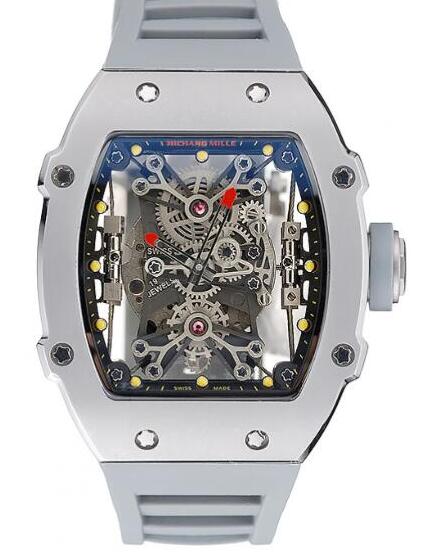 |
|
The administrator has disabled public write access.
|